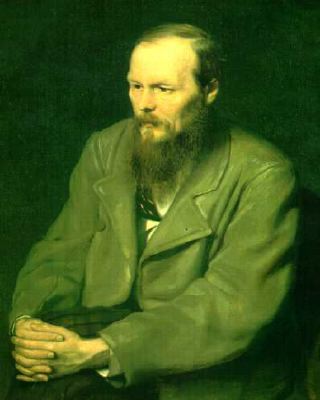
Reading this grand and long work for the first time achieved a long term ambition of mine - and I am glad I have read it at last. I read
a Penguin edition published in 2003 , translated by David McDuff in 1993.
The themes and story line
The book explores a number of strong themes including - ethics and patricide , jealousy , religious commitment and doubt, guilt and redemption, childhood and children, psychological insights into an individual's behaviour , exploitation of lower classes and women and a time of political change and social change. It is often deeply philosophical and then by contrast becomes , in the second half especially , a very dramatic story. This story revolves around a family of reasonable but not great wealth consisting of a father and his three sons . The story is set in a small town community in Russia . The central drama is the murder of the father and the consequent suspicion of patricide by one of his sons.
Leading up to this drama , which includes the collection of evidence and a long court room scene, there are whole chapters and passages setting out the background of each of the main characters and the social and religious world surrounding them . For instance , we dont just hear about the monastery and monks who are important in the early part of the story , we receive extensive insights into their dogmas and practices . There are whole arguments put before us of the way to salvation and otherwise. In fact the extent and intent of the religious discussion in the book surprised me . I think a reader of Victorian English classic fiction is not really familiar with this depth of discussion about conscience, for instance. I became enmeshed in the very "Russian" atmosphere depicted here which was a large part of the enjoyment.
Humour and farce are also strong characteristics of the novel. The rollicking nature of the work at times amuses considerably and gives balance to the starker aspects of the social scenes and the story itself. A series of Chapters in Book IV called "Crack-ups" presents some humorous and even ridiculous scenes in drawing rooms and other settings involving affairs of the heart and various mix-ups. It is pertinent to note here that one of the sub-plots revolves around the rivalry of the father of the family and one at least of his sons for the love and affection of Grushenka a worldly , yet put-upon young woman . I found reading about her and watching her reactions , as described by the narrator, particularly insightful into the restrictive yet changing society we are presented with. Here I would like to mention that I also found the work distinctly full of the sounds of society - the talking , calling out and singing of the people and other sounds of the countryside and the town. It resonated very strongly for me.
Some of the Characters
The father of the family, Fyodor Pavlovich Karamazov exploits his own sons , is self indulgent , and , has been indifferent to and at times cruel when bringing up his sons. We meet this ageing patriarch at a slightly more sympathetic if pathetic , vulnerable time of his life . He delights in almost childlike , outrageous behaviour at the expense of others . His personality casts a strong and ambiguous shadow over the drama.
His three sons are Mitya, Ivan and Alyosha . Mitya , the eldest , was the child of Fyodors first wife and Ivan and Alyosha are the sons of the second wife. Both of the mothers died before their sons were grown up and the boys were looked after by foster parents . Mitya has a full-on personality a little like his father but he has a kinder nature . He is accused of the murder but who is really guilty and of what does guilt consist? Ivan is very thoughtful and working painstakingly through the philosophical considerations of an atheist. Alyosha is saintly by comparison to his brothers and considers becoming a monk but decides against it. He forms a vital link with all the players in the story . Smerdyakov, thought to be an illegitimate son of Fyodor who keeps him as a servant, is more than likely the actual murderer. Of the female characters , Grushenka ,is perhaps the most fascinating whilst several other of the women have relatively minor but socially poignant roles. One of the sub-plots revolves around a group of school boys and the lingering death of one of them - with the boys characters and roles dealt with in some depth.
A note on the structure and influences
The story is told to us by a narrator who is in turn a character. He has opinions and observations about what is going on which are entertaining in themselves. He has been described in the introduction to my edition as a sort of "grotesque… Hoffmanesque" character. He is conservative and sometimes crabby, particularly about women . The author's voice comes through as well at times and the result is a mixed, far from simple rich sound and a scenic tapestry - requiring one to concentrate and listen well. It is worth the effort may I add. It was originally published in serial sections over about 18 months . It was then published in book form in 1880 only a few months before the author died. Dostoyevsky experienced deep tragedy in his life including penal servitude in Siberia and the loss of a dear young son from epilepsy just before he started on this work. He went on a pilgrimage to a hill top Orthodox monastery before he started the novel when grieving for the loss of his son. These experiences are said to have informed some of the action and concerns of the work.
My overall impressions
"The Brothers Karamazov" introduced me to a new and unexpected reading experience - even "War and Peace" did not prepare me for the richness of style and range of emotions set out for us in this tragic family saga. There are many sub-plays going on and it deals a lot with personal psychology. There are also wonderful descriptions of Russian small town life, the countryside and the ways of going about day to day life to fill many a novel. The inter- reactions of groups of characters including inter-generational ones are engrossing , sometimes dangerous, and also often tender.
One is of course reading a great classic in translation . The David McDuff translation read lyrically and well - further evidence for me that the work is lyrical in the original also. It is a kaleidoscopic work and I know I cannot do it justice in these few words - I hope to give you the impression however - this is a major reading adventure.
As someone reasonably familiar with the English Victorian classics , "The Brothers Karamazov" (1880) was different from the English greats of the near period , Dickens and Elliot for instance , - engaging yet a little difficult too. It required concentration and imagination to picture the amazing social and action scenes and follow the philosophical arguments and thought processes of the characters. I would be delighted to hear from any other reader who is familiar with the work and to hear of your reactions.
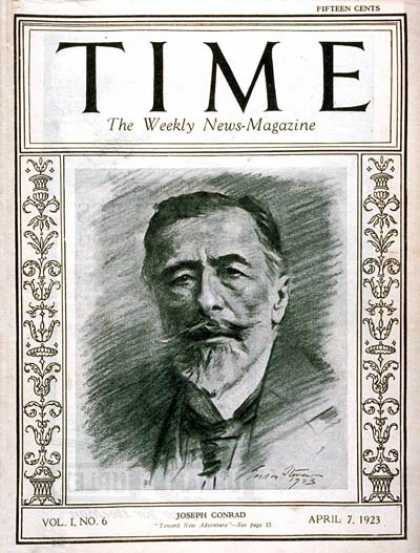
Heart of Darkness by Joseph Conrad
Joseph Conrad (1857-1924) the Polish born former merchant seaman and ship's captain who learnt English as an adult and established himself firmly in the canon of great English novelists, was irritated when admirers used to ask him 'when are you going to spin us another yarn of the sea'. His annoyance was understandable: far from being a casual spinner of tales, Conrad was the most painstakingly and consciously artistic of writers. But the thoughtless questions were at least somewhat understandable: Conrad's novels do often concern the sea, and they are very often set in parts of the world which in his time seemed exotic to British and American audiences.
Heart of Darkness, a short work probably best described as a novella, is mostly set not at sea but on a great unnamed river (in fact the Congo in what was then the Congo Free State, a vast African domain brutally ruled as a private estate by the Belgian king Leopold II). But the setting is certainly exotic, and in a literal sense the journey up river is a journey into the interior, or heart, of what in 1899, when the work was first published in part form, was often called the 'Dark Continent'. It involves encounters with naked black people who are unquestionable presented as primitive and cannibalistic, and an attack by them on the Europeans' steamer is a major incident in the book. But a lot more is involved, and Heart of Darkness has become one of the most discussed and debated books in the 'canon' of twentieth century literature.
Darkness is a pervasive element in the book. The African jungle is dark and sombre, its people lack the civilisation of Europe. But Europe and Europeans are no strangeness to darkness. The book opens with night falling on a ship moored in the Thames, where the narrator Marlow relates the story to four listeners, and a major scene towards the end takes place in a darkening drawing room in Western Europe. We are reminded that the Thames and England probably once seemed as dark and frightening to visitors from Rome as Africa does to people of the narrator's time. The symbolism of light and darkness in the novel is a major element.
More important than physical darkness is the darkness which can overwhelm the human soul. The purpose of the river voyage is to bring out from the interior a man called Kurtz, who is said to be behaving very strangely in his isolation from all other Europeans, and who, it emerges, has used barbaric brutality to make himself into a sort of god for the native people. Kurtz, however, is in many ways an exceptional person, intelligent, multi-talented, and idealistic. He towers above the other Europeans Marlow encounters in Africa, who emerge as petty, stupid, indolent, and greedy. It could be said that Kurtz (despite his intellect, or because of it) has entered into a personal heart of darkness, and gone mad as a consequence. His last words as he dies on the voyage back to the coast -'The horror! The horror!' is a comment on what he has found.
T.S. Eliot used a black servant's announcement 'Mistah Kurtz - he dead' as an epigraph for his major poem 'The Hollow Men' but arguably the novella is more about the journey of the narrator Marlow than about Kurtz. Like many other aspects of the book, the impact of Marlow's physical and spiritual journey is not easy to summarise concisely or with confidence. Certainly the journey profoundly affects him, and makes him more dissatisfied with life in Europe, but it is difficult to know what to make of the climax of a strangely memorable scene near the end of the book, when Marlow falsely tells Kurtz's fiancee that her intended died with her name on his lips. A desire to spare a grieving women further grief? A chivalric wish to help her maintain her illusions? A failure in honesty and courage on the part of Marlow? A reflection of his awareness that only those who have been to the heart of the darkness within themselves and within humanity can really be expected to understand it, and it is pointless to try to explain it?
Some have seen Heart of Darkness as a book condemning colonialism and imperialism. Certainly it gives no nobility to the Europeans in Africa, emphasising their rapacity, and suggests that the Africans who accept European ways become rather ridiculous figures. The Nigerian novelist Chinua Achebe famously denounced the novella as racist, denying Africans a voice and a humanity, and we must probably conclude that in his attitude to them Conrad was of his time, or only a little ahead of it.
Heart of Darkness is not always easy reading. It is immensely vivid, but the piling up of detail came seem overwrought, as no less a figure than F.R. Leavis suggested. It is an enigmatic work in many ways. But at the end of the few hours required to read it one feels sure one will never forget it.
Heart of Darkness, a short work probably best described as a novella, is mostly set not at sea but on a great unnamed river (in fact the Congo in what was then the Congo Free State, a vast African domain brutally ruled as a private estate by the Belgian king Leopold II). But the setting is certainly exotic, and in a literal sense the journey up river is a journey into the interior, or heart, of what in 1899, when the work was first published in part form, was often called the 'Dark Continent'. It involves encounters with naked black people who are unquestionable presented as primitive and cannibalistic, and an attack by them on the Europeans' steamer is a major incident in the book. But a lot more is involved, and Heart of Darkness has become one of the most discussed and debated books in the 'canon' of twentieth century literature.
Darkness is a pervasive element in the book. The African jungle is dark and sombre, its people lack the civilisation of Europe. But Europe and Europeans are no strangeness to darkness. The book opens with night falling on a ship moored in the Thames, where the narrator Marlow relates the story to four listeners, and a major scene towards the end takes place in a darkening drawing room in Western Europe. We are reminded that the Thames and England probably once seemed as dark and frightening to visitors from Rome as Africa does to people of the narrator's time. The symbolism of light and darkness in the novel is a major element.
More important than physical darkness is the darkness which can overwhelm the human soul. The purpose of the river voyage is to bring out from the interior a man called Kurtz, who is said to be behaving very strangely in his isolation from all other Europeans, and who, it emerges, has used barbaric brutality to make himself into a sort of god for the native people. Kurtz, however, is in many ways an exceptional person, intelligent, multi-talented, and idealistic. He towers above the other Europeans Marlow encounters in Africa, who emerge as petty, stupid, indolent, and greedy. It could be said that Kurtz (despite his intellect, or because of it) has entered into a personal heart of darkness, and gone mad as a consequence. His last words as he dies on the voyage back to the coast -'The horror! The horror!' is a comment on what he has found.
T.S. Eliot used a black servant's announcement 'Mistah Kurtz - he dead' as an epigraph for his major poem 'The Hollow Men' but arguably the novella is more about the journey of the narrator Marlow than about Kurtz. Like many other aspects of the book, the impact of Marlow's physical and spiritual journey is not easy to summarise concisely or with confidence. Certainly the journey profoundly affects him, and makes him more dissatisfied with life in Europe, but it is difficult to know what to make of the climax of a strangely memorable scene near the end of the book, when Marlow falsely tells Kurtz's fiancee that her intended died with her name on his lips. A desire to spare a grieving women further grief? A chivalric wish to help her maintain her illusions? A failure in honesty and courage on the part of Marlow? A reflection of his awareness that only those who have been to the heart of the darkness within themselves and within humanity can really be expected to understand it, and it is pointless to try to explain it?
Some have seen Heart of Darkness as a book condemning colonialism and imperialism. Certainly it gives no nobility to the Europeans in Africa, emphasising their rapacity, and suggests that the Africans who accept European ways become rather ridiculous figures. The Nigerian novelist Chinua Achebe famously denounced the novella as racist, denying Africans a voice and a humanity, and we must probably conclude that in his attitude to them Conrad was of his time, or only a little ahead of it.
Heart of Darkness is not always easy reading. It is immensely vivid, but the piling up of detail came seem overwrought, as no less a figure than F.R. Leavis suggested. It is an enigmatic work in many ways. But at the end of the few hours required to read it one feels sure one will never forget it.
The Finkler Question by Howard Jacobson
In October this novel won its author the 2010 Man Booker Prize for fiction. It was highly praised by the judges: Andrew Motion, the chair of the panel, described it as ‘a marvellous book: very funny, of course, but also very clever, very sad and very subtle. It is all that it seems to be and much more than it seems to be. A completely worthy winner of this great prize’. Much of the published critical reaction has also been very enthusiastic. However, a check of customer reactions on the Amazon.com website tells a different story. There is certainly some enthusiasm, but a lot of the commentators speak of their disappointment, and of finding the book tedious, boring, and impossible to finish.
Although by his own admission not an observant Jew, Jacobson is a writer very conscious of his Jewish background and heritage, and this, apparently like many of his other books (though Redback set in Australian academia is an exception) focuses very much on the experience of being Jewish today. Set in London, its primary focus is on Julian Treslove, a melancholy middle-aged and middle class man who seems never to make much success of anything he tries. Prominent in the novel are two Jewish men, both recently widowed, the elderly Libov, who once had a successful journalistic career which brought him into contact with celebrities, and Samuel Finkler, a former schoolmate of Treslove’s but now a media celebrity on the basis of his work popularising (and trivialising) philosophy. Treslove and these two frequently meet together, and could be regarded as friends, though there is a good measure of rivalry and jealousy in the relationship between Treslove and Finkler.
Central to the novel is Treslove’s mugging one evening by a woman, who says something to him which he interprets as possibly being ‘You Jew’. This heightens in Treslove a desire to possess qualities he believes Jews to possess, and to become a Jew himself, a ‘Finkler’ as he calls it in his own mind, and much of the novel, which has little in the way of a ‘story line’, is concerned with his exploration of what being Jewish involves. (Perhaps surprisingly, the theology and religious beliefs of Judaism has little role in this. The emphasis is on social and attitudinal aspects of Judaism.) There is much introspection on Treslove’s part, and he and the reader encounter a great many varieties of Jewish experience, much of it involving anxieties and misgivings. A group called ‘ASHamed Jews’, in which Finkler plays a major role, though not without challenge, is prominent. This takes place against a background of significant anti-Semitism, which several of the Jewish characters, and one strongly suspects the author, see as a major problem threatening the physical and social well-being of Jews in countries like Britain today.
If the frequent suggestions that the novel is ‘very funny’ encouraged anyone to read it in the expectation of a good laugh, he or she would be disappointed. There are amusing moments, but much of the humour consists in the presentation of the bizarre, the offbeat, the hyperbolic – such as the Jewish man trying to reverse the physical effects of circumcision. Some critics have praised the characterisation, but readers may find it a problem that the characters are presented with little warmth or humanity. Treslove is a rather tiresome ‘loser’: he does not conspicuously display qualities of decency and honesty which redeem other losers in literature, and the fact that women are attracted to him, albeit some briefly, and two have borne sons to him, strains credulity. Finkler is frankly rather unpleasant, and Libov does not emerge far from the ‘elderly Mitteleuropa Jew’ stereotype. The female characters rarely if ever become more than foils to the men – this is perhaps most noticeable in the case of Hephzibah, who becomes Treslove’s partner in a relationship which seems to offer remarkably little to her.
Perhaps the greatest success of the novel is in its treatment of male grief. Neither Libov nor Finkler had a perfect marriage relationship, though Libov came a lot closer than the frequently unfaithful Finkler, and each feels quite complex emotions as they come to terms with their loss. Jacobson must also be credited with writing prose that is invariable lucid, and which carries the reader on even when he or she is suppressing an inward groan when yet more angst rears its head. The Finkler Question is probably to be regarded as a work for the connoisseur, no more readily and instantly enjoyable than the new classical music composition that the orchestra conductor slips in between the Rossini overture and the Tchaikovsky symphony, but it is interesting as an example of what expert opinion regards as outstanding novel writing at the beginning of the twenty-first century.
Although by his own admission not an observant Jew, Jacobson is a writer very conscious of his Jewish background and heritage, and this, apparently like many of his other books (though Redback set in Australian academia is an exception) focuses very much on the experience of being Jewish today. Set in London, its primary focus is on Julian Treslove, a melancholy middle-aged and middle class man who seems never to make much success of anything he tries. Prominent in the novel are two Jewish men, both recently widowed, the elderly Libov, who once had a successful journalistic career which brought him into contact with celebrities, and Samuel Finkler, a former schoolmate of Treslove’s but now a media celebrity on the basis of his work popularising (and trivialising) philosophy. Treslove and these two frequently meet together, and could be regarded as friends, though there is a good measure of rivalry and jealousy in the relationship between Treslove and Finkler.
Central to the novel is Treslove’s mugging one evening by a woman, who says something to him which he interprets as possibly being ‘You Jew’. This heightens in Treslove a desire to possess qualities he believes Jews to possess, and to become a Jew himself, a ‘Finkler’ as he calls it in his own mind, and much of the novel, which has little in the way of a ‘story line’, is concerned with his exploration of what being Jewish involves. (Perhaps surprisingly, the theology and religious beliefs of Judaism has little role in this. The emphasis is on social and attitudinal aspects of Judaism.) There is much introspection on Treslove’s part, and he and the reader encounter a great many varieties of Jewish experience, much of it involving anxieties and misgivings. A group called ‘ASHamed Jews’, in which Finkler plays a major role, though not without challenge, is prominent. This takes place against a background of significant anti-Semitism, which several of the Jewish characters, and one strongly suspects the author, see as a major problem threatening the physical and social well-being of Jews in countries like Britain today.
If the frequent suggestions that the novel is ‘very funny’ encouraged anyone to read it in the expectation of a good laugh, he or she would be disappointed. There are amusing moments, but much of the humour consists in the presentation of the bizarre, the offbeat, the hyperbolic – such as the Jewish man trying to reverse the physical effects of circumcision. Some critics have praised the characterisation, but readers may find it a problem that the characters are presented with little warmth or humanity. Treslove is a rather tiresome ‘loser’: he does not conspicuously display qualities of decency and honesty which redeem other losers in literature, and the fact that women are attracted to him, albeit some briefly, and two have borne sons to him, strains credulity. Finkler is frankly rather unpleasant, and Libov does not emerge far from the ‘elderly Mitteleuropa Jew’ stereotype. The female characters rarely if ever become more than foils to the men – this is perhaps most noticeable in the case of Hephzibah, who becomes Treslove’s partner in a relationship which seems to offer remarkably little to her.
Perhaps the greatest success of the novel is in its treatment of male grief. Neither Libov nor Finkler had a perfect marriage relationship, though Libov came a lot closer than the frequently unfaithful Finkler, and each feels quite complex emotions as they come to terms with their loss. Jacobson must also be credited with writing prose that is invariable lucid, and which carries the reader on even when he or she is suppressing an inward groan when yet more angst rears its head. The Finkler Question is probably to be regarded as a work for the connoisseur, no more readily and instantly enjoyable than the new classical music composition that the orchestra conductor slips in between the Rossini overture and the Tchaikovsky symphony, but it is interesting as an example of what expert opinion regards as outstanding novel writing at the beginning of the twenty-first century.
Subscribe to:
Posts (Atom)