"The Secret River" by Kate Grenville was first published in 2005 to critical acclaim. It is an historical novel set around the Hawkesbury area near Sydney in the first two decades or so of the nineteenth century. The main character is William Thornhill ,who was transported to New South Wales aboard the ship Alexander “for the term of his natural life” for stealing some timber he was delivering as part of his work as a ferryman on the Thames. His wife Sal, a free woman, was allowed to come on the transport to Sydney too - in a separate section of the ship.
In the first chapter “Strangers” we meet William lying awake beside his sleeping wife and new born child in a wattle-and-daub hut in Sydney in 1806 listening to the eerie sounds of this new strange place . He gets up from the bedding and goes outside into the night and comes face to face with an Aboriginal man - the “strangeness” of it all is palpable. This first chapter sets out the tone and the powerful themes of the book - fear, courage, ambition, greed,usurpation, misunderstanding and the great difficulty of communication across cultures .
After this first chapter the book goes back to London and places the story in its context with what life was like for William and Sal growing up and marrying, leading up to their transportation to New South Wales . The research undertaken by the author illuminates this background chapter in an exciting way. We feel we know these people through their young life stories and expectations and therefore have empathy with them as they struggle to work out an existence in the new colonial settlement of Sydney.
The main adventurous part of the novel however takes place in the Hawkesbury River and upper reach farmland area near Sydney . William gains his emancipation certificate after a few years in Sydney and moves to the Hawkesbury , takes up some land and plies his old trade of ferryman by shipping farm produce from the farms to Sydney which hungers for it and returns with goods for the settler farmers. Life is very hard for these river settlers who for the most part have simply squatted on these lands , fenced them rudely and started out growing corn etc. The Aboriginal owners who live in and around the countryside and the river area foraging, fishing, hunting, camping and celebrating are pushed further and further away with often tragic outcomes.
The central tragedy in the story is a massacre by the settlers of an Aboriginal clan who were seen as the enemy - a very sad story of violence and counter-violence. William takes part in this tragic violent act , albeit reluctantly . It has a lasting effect on him.
However the story moves on as do the dispossessed Aborigines . The Thornhill’s prosper and set themselves up with a comfortable life with their five children. At the end we see an ageing William sitting on his sandstone verandah at "Wiseman's Ferry"looking pensively through a telescope at the wooded cliffs wondering if “they” were there.
“even after the cliffs had reached the moment at sunset where they blazed gold , even after the dusk left them glowing... even then he sat on, watching, into the dark”.
This descriptive language ,whilst economical throughout the story , lends the book its special beauty both in the sketching of the natural surroundings and in setting up the relationships and the inner thoughts of the main characters.
The characterisation of the Thornhills , William and Sal, their children and the other settlers is very believable. Sal, for instance, is striving to return home to London and we learn she sees herself with “a five year sentence” before she can achieve her dream , yet we know William is yearning to be a landowner and make a new life for himself and family. Each is nervous about their separate dreams and careful to protect each other from the other’s yearnings as they toil to live in the very harsh circumstances for the first several years. There are caring people among the settlers as well as selfish, unthinking and at times violent people . Grenville brings these minor characters illuminatingly to life and the story is the richer for this.
All the more remarkable ,then, was the decision by the author to not use pidgin English for the Aborigines in the first encounters in order to gain as much verisimilitude with what would have been happening and how the experience would have been from the settlers point of view and the Aboriginal people of the area. I think this works and we see the Aboriginals in the story as real people - caring for their way of life . Their tragedy of being misunderstood , treated condescendingly and often with contempt and violence gives the story much of its poignancy and power.
Kate Grenville wrote another book about how she came to this story and the research she undertook for it - “Searching for the Secret River” . This is recommended too because it brings out so much of interest for the reader about the writing of engaging historical fiction. There was some controversy with some historians at the time of publication - Grenville was thought to have claimed too much historical significance for the novel. “Searching....” is a very thorough answer to this issue in my opinion. We know , for instance, that Grenville’s ancestor was Solomon Wiseman who settled in the Hawkesbury area and is remembered in the town name of Wiseman’s Ferry. Wiseman , a Thames ferryman, was transported for theft , along with his free woman wife , Janet , in the “Alexander” which was an actual convict ship . The Wisemans arrived in Sydney in 1806. The author’s research in London for original records and local colour is well set out in this latter book too. Grenville has said in answer to the controversy that she does not claim her novel as a work of history as such and that there has been some misunderstanding of her words in an interview re the historical nature of the work. Her website contains this information and story for anyone who wishes to explore this further.
However in the end what we have is a work of fiction , beautifully written and realised ,informed by research and strong personal interest. It brings a section of Colonial Australian history to life and allows the imagination to ponder the circumstances surrounding these people both colonisers and original owners with empathy and some wonder.
'Mad World: Evelyn Waugh and the Secrets of Brideshead' by Paula Byrne
Unlike the subjects of almost all the previous postings to the Classic Readers blog, the book now under consideration is not a novel. It is instead essentially a biography - of the novelist Evelyn Waugh. But unlike several earlier biographers of the novelist, Paula Byrne very deliberately sets out not to provide a 'cradle to grave' account of her subject, but instead to focus on his relationship with a family and the stately home of that family, and to explore the ways in which that relationship fed into the creation of what is probably Waugh's most famous novel, Brideshead Revisited.
The family in question is the Lygons, the children of the seventh Earl Beauchamp, and the house is their country house Madresfield, commonly referred to by the family and their friends as 'Mad'. Waugh first visited it as a young graduate in 1931, and over the next few years he was a frequent visitor who greatly enjoyed the opportunities to partake of its comfortable aristocratic splendour and spend time with the family, and in particular three of the daughters, with at least two of whom he developed close and lifelong platonic friendships. The situation at Madresfield in the early 1930s was unusual, in that neither the earl nor his wife was present, and the young people had a fully staffed and functioning major English country house at their disposal. The earl had left England in disgrace to avoid the legal and social consequences of a homosexual scandal, and his wife had divorced him and moved with her youngest son to a house near a home of her brother, the Duke of Westminster, the earl's fiercest enemy. Waugh had known two of the Lygon brothers William and Hugh at Oxford, and had been particularly close to the younger, Hugh, generally agreed to be the main model for Sebastian Flyte in Brideshead, though at least one reviewer has expressed misgivings regarding Byrne's ready acceptance of the view that the two were involved in a homosexual relationship.
Paula Byrne vigorously asserts in her preface that she is writing a new kind of biography, and states that the heyday of the comprehensive biography is past. This has clearly somewhat riled some reviewers, who claim that most of what she presents is not new, though they acknowledge that she has ferreted out some previously unknown details, notably regarding the divorce of the earl and his wife, and Evelyn's Catholic confirmation in Rome. Whatever the merits of this criticism, Byrne had undoubtedly written a lively, entertaining, and generally very readable book which evokes the world it describes very vividly.
I found particularly fascinating the parts dealing with Waugh's boyhood and his time at Oxford, and the account of the Lygon family before Waugh's first visit to Madresfield. The narative of the visits, and his interactions with the Lygon's during the few years between 1931 and the house's passing into the ownership of the eldest Lygon son and his wife on the death of the seventh earl, is interesting, but perhaps the detailed account of this world of nicknames, in-jokes, and special jargon which united the participants does untimately become just a little tedious. The milieu described does seem to have been rather frivolous and self-indulgent.
A significant part of the book is involved in tracing the links between the Lygons and the characters in Brideshead Revisited , and between the house Madresfield and Brideshead in the novel. The existence of such a relationship has been known from the time the novel was first published in 1945, and Jane Mulvagh dealt with the topic in her book Madresfield. The extent to which one feels such analysis contributes to a literary appreciation of the novel will depend on one's approach to literary criticism. I had a literary education which discouraged exploration of such parallels and insisted on a focus on the novel itself, but it must be admitted that Byrne presents a lot of interesting material.
Eveyln Waugh (1903-66) has a reputation as a considerable writer and a rather unpleasant person - snobbish, rude, and curmudgeonly. Byrne sets out to correct this view of his personality, and she provides much evidence that he could be a loyal and generous friend. She suggests that to some extent he became a victim of a persona he created, acknowledging that it did in fact largely take over his being later in life, when he found himself increasingly out of sympathy with the postwar world and the post-Vatican II Catholic Church.
Mad World is an easy and entertaining read. For this reader, it dragged just a little in the middle, but it was thoroughly enjoyable as a whole.
"The Brothers Karamazov" by Fyodor Dostoyevsky
Reading this grand and long work for the first time achieved a long term ambition of mine - and I am glad I have read it at last. I read
a Penguin edition published in 2003 , translated by David McDuff in 1993.
The themes and story line
The book explores a number of strong themes including - ethics and patricide , jealousy , religious commitment and doubt, guilt and redemption, childhood and children, psychological insights into an individual's behaviour , exploitation of lower classes and women and a time of political change and social change. It is often deeply philosophical and then by contrast becomes , in the second half especially , a very dramatic story. This story revolves around a family of reasonable but not great wealth consisting of a father and his three sons . The story is set in a small town community in Russia . The central drama is the murder of the father and the consequent suspicion of patricide by one of his sons.
Leading up to this drama , which includes the collection of evidence and a long court room scene, there are whole chapters and passages setting out the background of each of the main characters and the social and religious world surrounding them . For instance , we dont just hear about the monastery and monks who are important in the early part of the story , we receive extensive insights into their dogmas and practices . There are whole arguments put before us of the way to salvation and otherwise. In fact the extent and intent of the religious discussion in the book surprised me . I think a reader of Victorian English classic fiction is not really familiar with this depth of discussion about conscience, for instance. I became enmeshed in the very "Russian" atmosphere depicted here which was a large part of the enjoyment.
Humour and farce are also strong characteristics of the novel. The rollicking nature of the work at times amuses considerably and gives balance to the starker aspects of the social scenes and the story itself. A series of Chapters in Book IV called "Crack-ups" presents some humorous and even ridiculous scenes in drawing rooms and other settings involving affairs of the heart and various mix-ups. It is pertinent to note here that one of the sub-plots revolves around the rivalry of the father of the family and one at least of his sons for the love and affection of Grushenka a worldly , yet put-upon young woman . I found reading about her and watching her reactions , as described by the narrator, particularly insightful into the restrictive yet changing society we are presented with. Here I would like to mention that I also found the work distinctly full of the sounds of society - the talking , calling out and singing of the people and other sounds of the countryside and the town. It resonated very strongly for me.
Some of the Characters
The father of the family, Fyodor Pavlovich Karamazov exploits his own sons , is self indulgent , and , has been indifferent to and at times cruel when bringing up his sons. We meet this ageing patriarch at a slightly more sympathetic if pathetic , vulnerable time of his life . He delights in almost childlike , outrageous behaviour at the expense of others . His personality casts a strong and ambiguous shadow over the drama.
His three sons are Mitya, Ivan and Alyosha . Mitya , the eldest , was the child of Fyodors first wife and Ivan and Alyosha are the sons of the second wife. Both of the mothers died before their sons were grown up and the boys were looked after by foster parents . Mitya has a full-on personality a little like his father but he has a kinder nature . He is accused of the murder but who is really guilty and of what does guilt consist? Ivan is very thoughtful and working painstakingly through the philosophical considerations of an atheist. Alyosha is saintly by comparison to his brothers and considers becoming a monk but decides against it. He forms a vital link with all the players in the story . Smerdyakov, thought to be an illegitimate son of Fyodor who keeps him as a servant, is more than likely the actual murderer. Of the female characters , Grushenka ,is perhaps the most fascinating whilst several other of the women have relatively minor but socially poignant roles. One of the sub-plots revolves around a group of school boys and the lingering death of one of them - with the boys characters and roles dealt with in some depth.
A note on the structure and influences
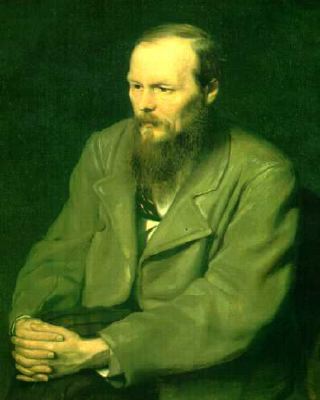
The story is told to us by a narrator who is in turn a character. He has opinions and observations about what is going on which are entertaining in themselves. He has been described in the introduction to my edition as a sort of "grotesque… Hoffmanesque" character. He is conservative and sometimes crabby, particularly about women . The author's voice comes through as well at times and the result is a mixed, far from simple rich sound and a scenic tapestry - requiring one to concentrate and listen well. It is worth the effort may I add. It was originally published in serial sections over about 18 months . It was then published in book form in 1880 only a few months before the author died. Dostoyevsky experienced deep tragedy in his life including penal servitude in Siberia and the loss of a dear young son from epilepsy just before he started on this work. He went on a pilgrimage to a hill top Orthodox monastery before he started the novel when grieving for the loss of his son. These experiences are said to have informed some of the action and concerns of the work.
My overall impressions
"The Brothers Karamazov" introduced me to a new and unexpected reading experience - even "War and Peace" did not prepare me for the richness of style and range of emotions set out for us in this tragic family saga. There are many sub-plays going on and it deals a lot with personal psychology. There are also wonderful descriptions of Russian small town life, the countryside and the ways of going about day to day life to fill many a novel. The inter- reactions of groups of characters including inter-generational ones are engrossing , sometimes dangerous, and also often tender.
One is of course reading a great classic in translation . The David McDuff translation read lyrically and well - further evidence for me that the work is lyrical in the original also. It is a kaleidoscopic work and I know I cannot do it justice in these few words - I hope to give you the impression however - this is a major reading adventure.
As someone reasonably familiar with the English Victorian classics , "The Brothers Karamazov" (1880) was different from the English greats of the near period , Dickens and Elliot for instance , - engaging yet a little difficult too. It required concentration and imagination to picture the amazing social and action scenes and follow the philosophical arguments and thought processes of the characters. I would be delighted to hear from any other reader who is familiar with the work and to hear of your reactions.
Subscribe to:
Posts (Atom)